
When Marketing Meets Thermodynamics, Somebody's Going to Get Burned.
You’ve probably heard the pitch: “Our AI uses physics-based models for explainability and accuracy.” It sounds compelling. After all, physics represents fundamental truth, right? The laws of nature, equations chiseled into the foundations of the universe.
Not so fast.
The First Problem: There Is No Equation
Let’s start with a simple challenge. Write me an equation for the wet burst strength of paper towels.
I’ll wait.
How about the flavor profile of an oak-aged whiskey? The exact moment a chemical reactor will foul? The optimal blend ratio for your specific crude slate on Tuesday afternoon?
These aren’t trick questions. They’re real industrial predictions that companies need to make every day. And here’s the uncomfortable truth: there is no physics equation for most of what we actually need to predict.
Physics gives us beautiful mathematics for ideal systems. Industrial reality gives us chaos, complexity, and a thousand variables interacting in ways that no one has ever bothered to write down in a journal—because they can’t.
The Second Problem: "Physics" Means "Ideal"
Remember PV = nRT from chemistry class? It’s elegant. It’s fundamental. It describes how pressure, volume, and temperature relate for a gas.
Wait—an ideal gas.
Now let’s get real. How does our friend “Pivnert” handle a high-pressure gas going in and out of solution in an emulsion of tar, water, salts, waxes, and oil? What happens when the equipment volume changes as it waxes up during operation?
It doesn’t work. That equation you learned in sophomore year assumes conditions that simply don’t exist in your plant.
The Third Problem: "Explainable" Doesn't Mean What You Think It Means
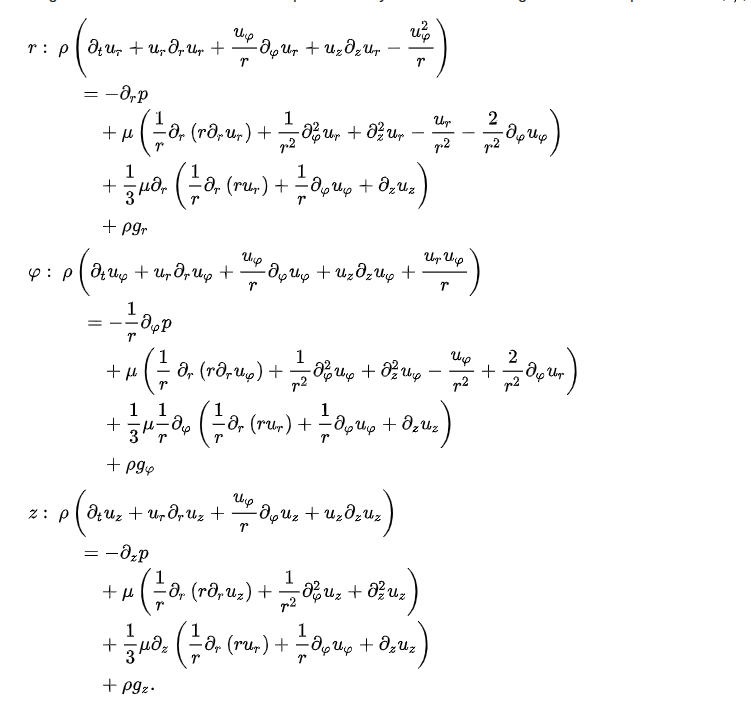
Let’s talk about flowing that waxy tar emulsion through a pipeline. Physics-based model, right? Just pull up Navier-Stokes in cylindrical coordinates.
Oh, but wait:
- The viscosity isn’t constant—it’s a function of composition, pressure, temperature, and shear history
- The pipe is corroded in places (differently in each section)
- The emulsion has gas going in and out of solution
- You need to account for every straight run, elbow, valve, and pump curve
[Image: Navier-Stokes equations in cylindrical coordinates – a wall of partial differential equations]
Go ahead. Explain that to me. Tell me how those six coupled partial differential equations with boundary conditions are “explainable” in any meaningful sense.
After all, it’s a physics-based model, right?
Here’s a simpler example: Write me an equation for the water swirling in your toilet. Just water flow, nothing fancy. Still waiting? That’s because some problems are too complex for closed-form solutions, even when we know the underlying physics perfectly.
The Reality Check
We’ve seen this pattern repeatedly in industrial AI deployments. Vendors wave the “physics-based” flag like it’s a quality certification. They build elaborate models with impressive equations.
Then they hit 67% accuracy.
Meanwhile, data-driven models—the ones that actually learn from what your process does rather than what textbooks say it should do—deliver 97% accuracy.
Why? Because reality is not an ideal case. Reality does not play well with assumptions.
Your process knows things that equations don’t. It knows about the operator who runs things differently on night shift. It knows about the feedstock that arrived last Tuesday. It knows about the valve that’s been sticking for three weeks. It knows about a thousand interactions that no equation will ever capture.
The Bottom Line
Physics-based models aren’t bad. They’re useful for what they’re actually good at: idealized systems, first-principles understanding, and cases where you truly have no data.
But they’re not magic. They’re not automatically “better” than data-driven approaches. And they’re certainly not more explainable when you’re staring at a screen full of coupled Partial Differential Equations with 47 parameters that you had to tune anyway.
The next time someone tells you their industrial AI is superior because it’s “physics-based,” ask them to show you the equation. Ask them what assumptions they’re making. Ask them what their actual accuracy is on your process.
Then ask them if they’ve tried just learning from the data.
The Next Installment: Analysis of 95 LinkedIn Comments
We got 95 comments in 4 days on LinkedIn on this topic. Read our analysis of what the industry says here!